


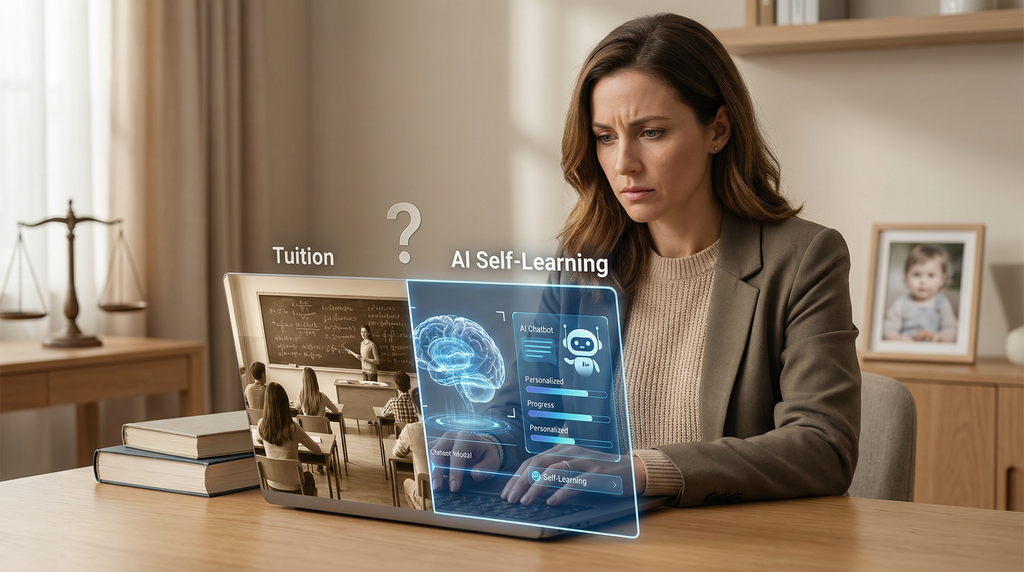
Tuition vs. Self-Learning in the Age of AI: What today’s Parents Need to Know
“Smart Learning Begins With the Right Balance.”
Parents today are more confused than ever about their children’s education. Schools encourage students to “Ask Google,” “Search YouTube,” or “Use ChatGPT to understand the chapter.” Children get homework that involves online research, and many teachers rely heavily on digital tools. At the same time, tuition centers are growing everywhere, and parents feel pressured to enroll their children to keep up with academic standards.
This raises the biggest question of modern education:
Is tuition better than self-learning - or is self-learning more important in today’s AI-driven world?
The truth is not one-sided. Both tuition and self-learning have strengths, and both have limitations. This article explains these differences in clear, simple language to help parents make the best decisions for their children.
1. How Learning Has Changed in the Age of AI
Ten years ago, students depended mainly on: Textbooks, Teachers in school, Tuition teachers at home
But today, a child’s first source of learning is often the internet. Whether it’s Google, YouTube, or an AI tool like ChatGPT, information is available instantly.
A student can now:
· Watch videos explaining complex topics
· Ask AI for step-by-step solutions
· Practice quizzes online
· Review sample essays
· Read summaries in minutes
This means children are no longer limited to the teacher’s explanation or the textbook’s content. AI has opened a world of learning opportunities; but it has also created confusion and dependence on quick answers.
This is where the debate of tuition vs. self-learning becomes important.
2. What Tuition Provides (and Why It Still Matters)
Despite technological advances, tuition remains helpful for many children. Tuition provides:
Structure and Routine: Children study better when they have fixed timings. Tuition forces a child to sit down, focus, and understand concepts within a schedule.
Guided Learning: Not all children learn at the same pace. A tuition teacher can explain lessons slowly, repeat difficult points, and make sure the child is truly understanding.
Accountability: Someone is supervising the child. This reduces distractions and ensures the child completes homework, revision, and practice.
Emotional Support: Many students feel shy to ask questions in school. During tuition, they feel more comfortable asking doubts.
Confidence Building: When a child receives personalized attention, their confidence improves, especially before exams.
But tuition also has limitations:
· Too much tuition makes a child dependent.
· Students wait for teachers to explain instead of trying themselves.
· Children lose free time, creativity, and play.
· Some tutors focus only on exam preparation, not real understanding.
So while tuition helps, it should not replace curiosity and independent thinking.
3. What Self-Learning Offers and Why It Is Becoming More Important
Self-learning means the child is willing to understand things on their own. In the past, it simply meant reading books independently. Today, self-learning includes:
· Watching concept videos
· Reading online explanations
· Asking AI questions
· Practicing quizzes
· Exploring topics outside the syllabus
Self-learning helps build essential lifelong skills:
Problem-Solving Ability: When children try to understand something on their own, they learn to think and analyze.
Confidence in Learning: A child feels proud when they figure out an answer themselves.
Curiosity and Interest: Self-learning encourages children to explore beyond what the teacher says.
Real Understanding: Children learn deeply when they study at their own pace.
But self-learning also has challenges:
· Children may get distracted on screens.
· They may search for quick answers instead of learning the root concept.
· Mistakes may remain uncorrected.
· Some students don’t know where to start or how to manage time.
This is where guided support becomes important.
4. Tuition vs. Self-Learning: Which One Is Better for Your Child?
The simple answer is: Both are necessary. Both are incomplete without each other.
· Tuition helps build the foundation
· Self-learning builds confidence and independence
Together, they create a strong and successful student.
Think of it like this:
· Tuition is the training wheel
· Self-learning is learning to ride independently
· AI is the map or guidebook
· Parents are the support system
A child succeeds only when all four work together.
5. What Parents Need to Understand in This New Era
Parents play the most important role in balancing tuition and self-learning. Here is what modern parents should focus on:
Don’t depend completely on tuition: Tuition is support, not substitution. Children must learn to think for themselves.
Don’t fear self-learning: It does not mean the child is alone. It means they are growing intellectually.
Guide their screen time: Teach them how to use Google or AI tools responsibly.
Ask what they understood: Not “Did you finish homework?”, but “What did you learn today?”
Appreciate curiosity: If a child asks questions, it means their mind is active; this is a good sign.
Encourage a balance: Let the child explore topics independently but also get proper guidance when they struggle.
6. The Best Strategy: A Balanced Learning Plan
A smart learning routine look like this:
Tuition for:
· Difficult subjects
· Concept clarity
· Regular discipline
Self-learning for:
· Revision
· Practice
· Exploring new topics
· Using AI for better understanding
Parental support:
· Monitoring progress
· Encouraging questions
· Reducing pressure
· Giving emotional comfort
This balanced plan ensures the child learns deeply and confidently.
Closing Thoughts
Education is changing rapidly, but the goal remains the same: helping children learn, grow, and become independent thinkers. Technology like AI will continue to rise, and tuition will always have its place. But the most successful students will be those who know how to balance guidance with independent effort.
A child who can both learn from others and learn by themselves is ready for the future.
“Education becomes powerful when guidance meets independence.”